 SmartScroll
The short answer: large surveys consistently put adult phone screen time in the range of 4 to 5 hours a day, and reporting around a major 2025 research review noted that young people now average about 6.5 hours a day online. So if your number looks high, you have company. But the average is a poor target, because screen time harms track what the hours contain far more than how many there are. Two hours of unplanned feed scrolling does more damage than five hours of maps, messages, reading and video calls.
The numbers, honestly stated
- Adults: most large tracking surveys land in the 4-to-5-hours-per-day range for phone screen time, with total screen time (adding computers and TV) considerably higher. Exact figures vary by survey method, which is why we give a range rather than a fake-precise number.
- Young people: coverage of the 2025 Psychological Bulletin review (71 studies, nearly 100,000 participants) reported an average of 6.5 hours per day online, alongside the review's core finding linking heavy short-form video use to poorer attention and higher anxiety and stress. Sources are linked in our statistics roundup.
- The trend: every major survey shows the number climbing year over year since smartphones arrived, with short-form video the fastest-growing slice.
Why "am I above average?" is the wrong question
The average includes your navigation, banking, messages, music, and the boarding pass at the gate. None of that is the problem, and cutting it wins you nothing. Research keeps pointing at a specific slice: unplanned, algorithmically fed scrolling, the sessions you didn't decide to start and couldn't seem to end. Someone at 3 hours of mostly Reels is worse off than someone at 6 hours of mostly podcasts and FaceTime. Composition beats quantity.
The better benchmark: chosen vs stolen hours
Open Settings → Screen Time and sort your top apps into two buckets:
- Chosen: you decided to spend it and would spend it again. Keep it, guilt-free, whatever the total.
- Stolen: autopilot sessions on TikTok, Reels, Shorts or X that started on reflex. This bucket, not your total, is the health metric.
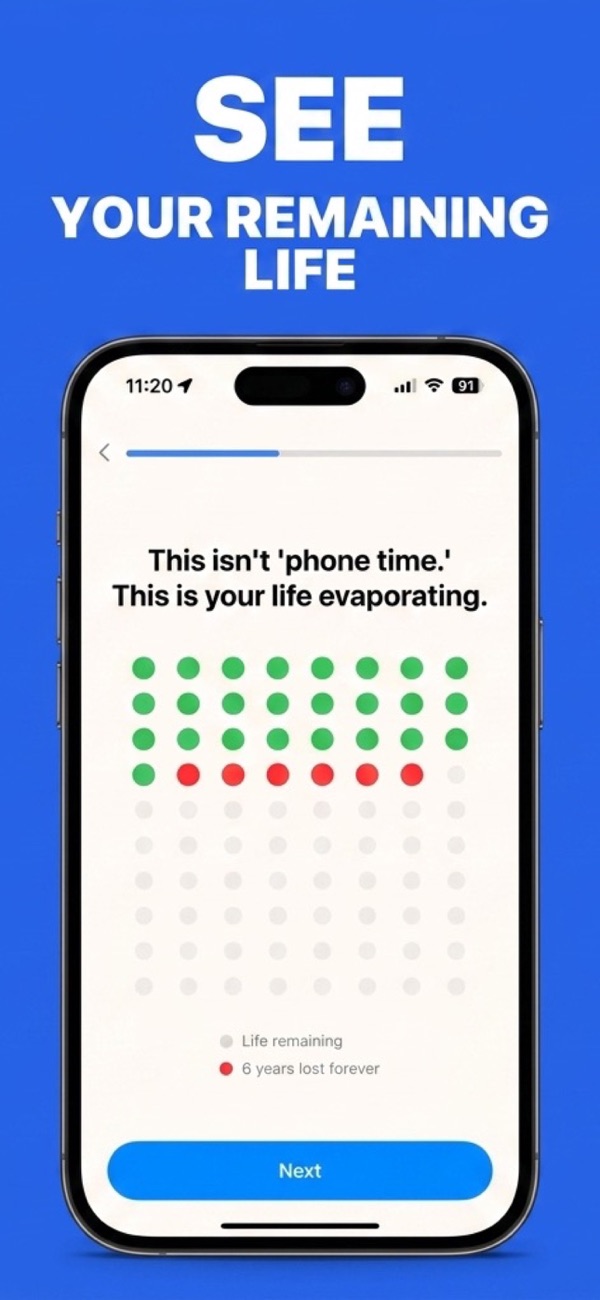
Most people find the stolen bucket holds 1.5 to 3 hours a day. Over an adult lifetime, 2 stolen hours a day is roughly 5 years of waking life, which is the arithmetic behind SmartScroll's Life Grid: your remaining years as a grid of dots, with the ones the current habit will consume marked in red.
How to shrink the stolen bucket (and only that one)
- Cap the feed apps in SmartScroll at roughly half their current usage, leaving everything else untouched.
- Let the interruption end the autopilot sessions. When a limit hits mid-scroll, SmartScroll breaks the loop and offers knowledge cards instead of the feed, so the swipe reflex gets a place to land.
- Protect the two danger windows with schedules: the first hour of the morning and the last hour before bed.
The full method is in how to reduce screen time on iPhone. Typical result: the total drops by 1.5 to 2 hours within a week, entirely out of the stolen bucket, and daily life gets easier rather than harder.
One-line answer for the curious: the average adult spends 4 to 5 phone hours a day and it keeps rising. Healthy isn't a number; it's a composition where the feed apps only get the time you chose to give them.
Measure yours in years, not minutes
Download SmartScroll and see what your screen time costs on the Life Grid.