 SmartScroll
The short answer: one sec and SmartScroll intervene at different moments. one sec adds friction before you open an app: a breathing exercise that makes impulsive opens conscious. SmartScroll intervenes at your limit, inside the habit: it interrupts the scrolling loop and replaces the feed with knowledge cards. Friction reduces how often you enter the feed; it does nothing about the 40-minute session once you're in. If your problem has moved from "I open Instagram too often" to "once I'm in, I can't stop," you've outgrown friction.
Side-by-side
| SmartScroll | one sec | |
|---|---|---|
| Intervention moment | At your daily limit, mid-session: the craving peak | Before the app opens |
| Mechanism | Interrupt the loop, redirect the swipe into knowledge cards | Breathing pause + "do you really want to open this?" |
| What the urge gets | A replacement behavior (scroll, but learn) | A delay |
| Evidence base | Habit-replacement principle: behaviors are replaced, not erased | Peer-reviewed studies with the Max Planck Institute, real credit |
| Price | Premium via in-app purchase | Free for one app; subscription for more |
| Motivation layer | Life Grid: screen time as years of remaining life | Stats on opens prevented |
| Weak spot | Leaves a conscious "1 more minute" choice by design | Strong cravings wait out the pause like a loading screen |
Where one sec genuinely wins
one sec deserves its reputation. The pre-open pause is validated by peer-reviewed research, it's elegant and non-punitive, and for mild habits, reflexively opening Instagram at every red light, it measurably cuts impulsive opens. If most of your problem is the number of times you enter the feed rather than what happens once you're inside, one sec (or the free ScreenZen) is a reasonable first tool.
Where friction runs out
Friction has a ceiling, and heavy scrollers find it fast. Three structural gaps:
- It guards the door, not the room. Once you're past the pause, the session is unguarded: the 40-minute spiral happens entirely on the far side of one sec's intervention.
- Cravings habituate to delays. The tenth time through the breathing exercise, it's not a moment of reflection anymore; it's a loading screen. You breathe, you open, you scroll.
- The urge gets nothing. A pause asks the scrolling reflex to evaporate. Habit research says reflexes don't evaporate: they get replaced, or they win.
What SmartScroll does instead
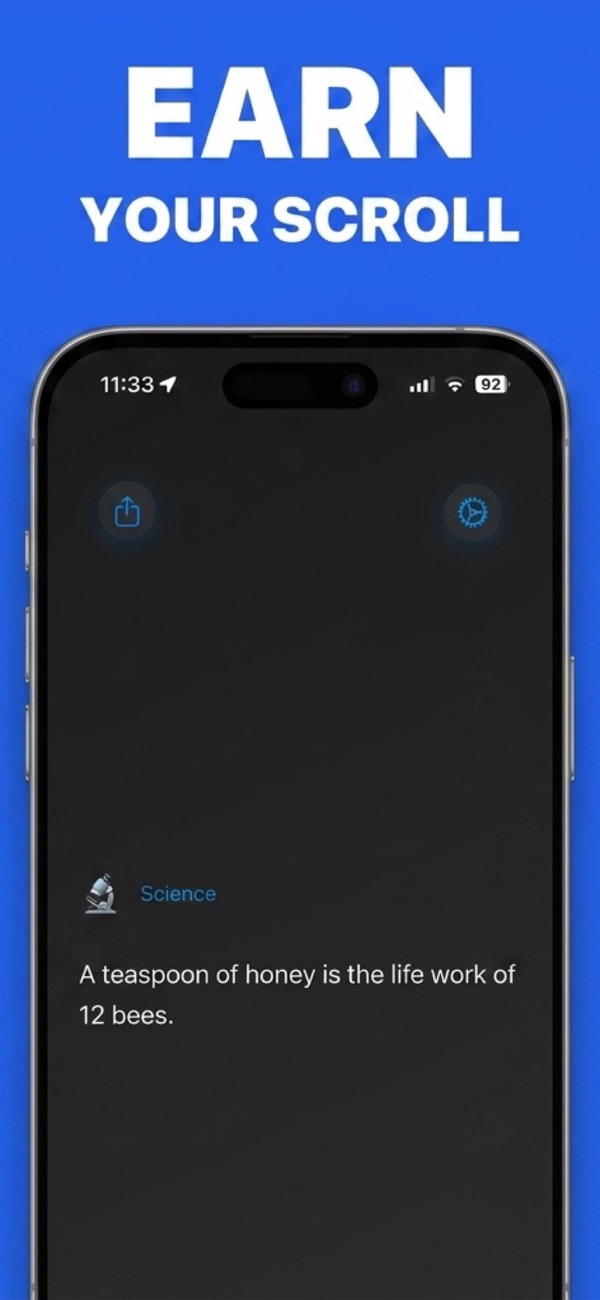
SmartScroll accepts the reflex and re-aims it. You set daily limits and schedules for TikTok, Reels, Shorts, X or any endless feed. When the limit hits, mid-session, at the craving peak, SmartScroll breaks the momentum ("The clock is ticking. You can't buy this minute back.") and offers the thumb something to do: bite-sized knowledge cards. Same gesture, opposite outcome: you surface from the scroll knowing something instead of feeling drained. The Life Grid then keeps the stakes visible, converting the habit into years of remaining life. That's the difference in one line: one sec makes opening harder; SmartScroll makes stopping easier.
They also stack well: one sec at the door, SmartScroll in the room. Friction on entry plus interruption at the limit covers both failure points. If you only run one, pick the one that matches where your habit actually beats you today.
Which should you pick?
- Pick one sec if your problem is frequent impulsive opens with short sessions, and a gentle science-backed nudge still stops you.
- Pick SmartScroll if your sessions run long once you're in, if the breathing pause has become muscle memory, or if you want the wasted time made visible instead of just counted.
When the pause stops working, redirect instead
Download SmartScroll and set your first limit in two minutes.